
 blog
blog
Is Argan Oil Good for Acne-Prone Skin? A 2026 Guide
Table of Contents
- Is Argan Oil Good for Acne-Prone Skin? The Honest Answer
- How Argan Oil Affects Sebum, Moisture, and the Skin Barrier
- Does Argan Oil Clog Pores? Comedogenic Ratings Explained
- How to Use Argan Oil on Your Face: A Step-by-Step Routine
- Argan Oil Side Effects on the Face: What to Watch For
- Argan Oil vs Jojoba Oil for Acne: Which Should You Choose?
- How Argan Oil Compares With Established Acne Treatments
- Conclusion: Should You Add Argan Oil to Your Acne Routine?
- Frequently Asked Questions
Last Updated: October 9, 2026
Is Argan Oil Good for Acne-Prone Skin? The Honest Answer
Is argan oil good for acne prone skin? Yes, for many people, with conditions, and the honest answer to "is argan oil good for acne prone skin" depends on how you use it.
At Renaissance de Beaute Argan Treatments, we sell pure organic argan oil, so we have a clear interest here.
Below: how argan oil affects sebum, what the comedogenic rating really means, how to use it without triggering breakouts, and when to stop.
How Argan Oil Affects Sebum, Moisture, and the Skin Barrier
Argan oil works on acne-prone skin in two ways: it helps balance oil production and supports the skin barrier.
Sebum Regulation and Oil Balance
Sebum is the oil your skin produces naturally. When harsh cleansers strip skin, it often responds by making more oil, the rebound effect many notice after over-washing.
A common approach is replacing harsh stripping with gentle moisture. Argan oil is high in linoleic acid, which oily and acne-prone skin tends to lack; a small amount can signal skin that it does not need to overproduce oil, which is why many with oily skin find a light facial oil helps rather than hurts.
Moisturizing Without Suffocating Pores
Argan oil absorbs quickly and leaves little residue, moisturizing without the heavy, coated feeling thicker oils leave behind, a balance that suits combination skin. A healthy barrier holds water in and keeps irritants out; when it is damaged, skin gets red, tight, and more breakout-prone. Argan oil's vitamin E and fatty acids help support that barrier.
Does Argan Oil Clog Pores? Comedogenic Ratings Explained
Argan oil has a low comedogenic rating, usually around 0 on the standard 0-5 scale, meaning it is unlikely to clog pores for most people. But the rating is not the whole story. How to read comedogenic claims:
- The scale measures how likely an ingredient is to clog pores in lab testing, not on your face
- Ratings vary by source, and some list argan oil at 0 while others say 2
- A low rating does not guarantee zero breakouts for every person
So does argan oil clog pores? For most people, no. But individual reactions vary, and your skin is the only real test.
How to Use Argan Oil on Your Face: A Step-by-Step Routine
The right way to use argan oil on your face: cleanse gently, apply a few drops to damp skin, and layer it under or over your moisturizer at night. Start slow and adjust as your skin responds.
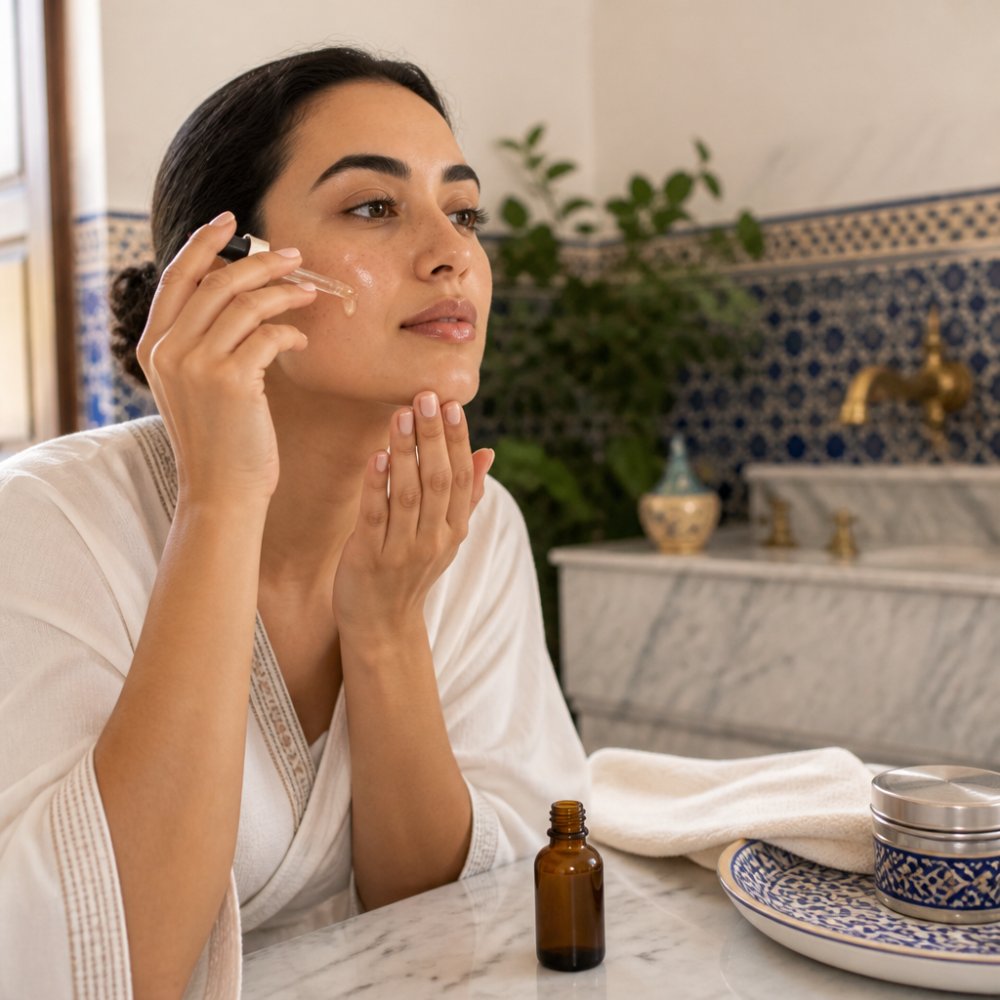
Follow these steps:
- Cleanse gently. Use a mild cleanser. Skip harsh scrubs on active breakouts.
- Pat skin damp. Do not towel it bone dry. Slightly damp skin absorbs oil better.
- Warm 2-3 drops between your fingertips. Less is more with facial oil.
- Press, do not rub. Pat the oil into your cheeks, jaw, and any dry patches.
- Skip active breakouts. Do not massage oil directly onto a fresh pimple.
- Follow with moisturizer if your skin feels like it needs more.
- Use it at night to start. See how your skin looks by morning.
How Much to Apply and How Often
Start with 2-3 drops, once a day, at night, and give it two weeks before judging results. If skin feels greasy, you used too much; if it feels tight by morning, add a drop. Oily and combination skin often do well with three to four nights a week; dry skin usually tolerates nightly use.
Argan Oil Side Effects on the Face: What to Watch For
Argan oil side effects on the face are rare but real. The most common is irritation or a mild allergic reaction, especially in sensitive skin or with a tree-nut allergy. Argan is a tree nut, so patch test with care, and with a known severe nut allergy, talk to your doctor first.
The Two Reactions People Confuse
The most common mistake is misreading what is happening on your face. Two patterns call for opposite responses:
Irritation or allergy, a reaction to the oil itself. It tends to show up fast, often within hours to a couple of days, and it looks like:
- Redness or warmth that was not there before
- Itching, stinging, or a rash
- Dry, scaly, or cracked patches
Purging or congestion, a reaction to what the oil is doing to your pores. It tends to build over one to two weeks and looks like:
- New tiny bumps or blackheads in the areas where you applied the oil
- Breakouts that get worse, not better, after two weeks
- Clogged-feeling skin, especially on the cheeks and jaw
The distinction matters: irritation means stop now; congestion means the oil is too heavy, cut back to a few nights a week or switch to a lighter option.
A Realistic Timeline
Give any new oil a fair test, but not an endless one:
- Nights 1-2: Patch test on your jawline only. Watch for redness, itching, or stinging.
- Days 3-7: If the patch test was clean, expand to the full face at 2-3 drops. Mild dryness relief is normal.
- Week 2: This is the judgment point. If breakouts are calming, keep going. If new bumps are appearing in the areas you applied it, the oil is not working for you.
When to Stop and When to See a Doctor
Stop using argan oil and give your skin a week to settle if you see redness, itching, a rash, stinging, or breakouts that worsen after two weeks. For a severe reaction, spreading rash, swelling, or trouble breathing, seek medical care right away. Separately, persistent or severe acne deserves a professional conversation regardless of what oil you use: cystic breakouts, scarring acne, and acne that has not responded to over-the-counter actives all signal that a dermatologist will do more than any product swap.
Argan Oil vs Jojoba Oil for Acne: Which Should You Choose?
Argan oil vs jojoba oil for acne is close, and the better pick depends on your skin type. Both are plant oils with low comedogenic ratings. Both can support the skin barrier.
| Feature | Argan Oil | Jojoba Oil |
|---|---|---|
| Texture | Light, absorbs fast | Light, waxy feel |
| Comedogenic rating | Low, around 0-2 | Low, around 2 |
| Key nutrients | Vitamin E, linoleic acid | Waxy esters, vitamin E |
| Best for | Dry, mature, combination skin | Oily, acne-prone skin |
| Main downside | Can feel heavy if overused | Can feel waxy on dry skin |
Jojoba is technically a liquid wax that closely mimics human sebum, making it a favorite for very oily skin. Argan brings more vitamin E and suits dry and mature skin better.
How Argan Oil Compares With Established Acne Treatments
Argan oil is not a substitute for proven acne treatments. Benzoyl peroxide, salicylic acid, and prescription retinoids have real evidence for clearing acne; argan oil does not. What it can do is sit alongside them and offset the dryness and irritation they cause, a supporting role, not a starring one. How the roles break down:
| What it does | Argan oil | Benzoyl peroxide | Salicylic acid | Retinoids |
|---|---|---|---|---|
| Kills acne bacteria | No | Yes | Limited | Indirectly |
| Unclogs pores | No | Yes | Yes | Yes |
| Normalizes skin-cell turnover | No | No | Mild | Yes |
| Reduces inflammation | Mild, from fatty acids and vitamin E | Yes | Yes | Yes |
| Supports the skin barrier | Yes | No, often dries it | No, can dry it | No, often irritates it |
| Typical evidence level for clearing acne | Low | High | High | High |
Read that table as a division of labor, not a competition. The actives do the clearing. Argan oil does the cushioning.
Why the Supporting Role Matters More Than It Sounds
Benzoyl peroxide, salicylic acid, and retinoids all irritate skin to some degree, that irritation is part of how they speed turnover and reduce bacteria. But a damaged barrier makes skin red, tight, and reactive, which is why so many quit an active before it works. A light, linoleic-acid-rich oil on off-nights can reduce that dryness without blocking the active's job; people who stick with a retinoid long enough to see results usually paired it with barrier support rather than white-knuckling through the peeling.
How to Layer Argan Oil With Acne Actives
Order and timing matter more than most expect. A workable approach:
- Cleanse and let skin dry completely before any active. Applying benzoyl peroxide or a retinoid to damp skin increases irritation.
- Apply the active first, benzoyl peroxide, salicylic acid, or your prescription retinoid, on clean, dry skin.
- Wait a few minutes for it to absorb. This reduces the chance of diluting it.
- Apply 2-3 drops of argan oil afterward if your skin feels tight or flaky. Oil layered over an active buffers the dryness without washing the active away.
- On off-nights, use argan oil alone as your moisturizing step.
Do not mix argan oil into the active in your palm first. Diluting an active reduces how much reaches the skin and makes it harder to tell what is helping and what is hurting.
What the Evidence Actually Shows
Be skeptical of any claim that argan oil clears acne. The honest state of the research:
- Argan oil has shown antioxidant and anti-inflammatory properties in lab work and small studies.
- Direct clinical research on argan oil as an acne treatment is limited.
- No major study shows argan oil clears acne on its own.
That is a correction of the marketing, not a knock on the oil. To clear active breakouts, reach for an active; to keep skin comfortable enough to stay on that active, argan oil earns its place.
If you are under a dermatologist's care, ask before adding any new oil to your routine. For a personalized walkthrough of what fits your routine, you can book a treatment consultation with our team, and our Renaissance Online Shop carries the pure organic argan oil referenced throughout this article.
Conclusion: Should You Add Argan Oil to Your Acne Routine?
Argan oil can be a good addition to an acne-prone routine, as long as you treat it as moisture support, not a treatment. It is non-comedogenic for most people, rich in vitamin E and fatty acids, and gentle on the skin barrier, but it will not clear breakouts by itself.
At Renaissance de Beaute Argan Treatments, we offer pure organic argan oil and traditional Hammam-inspired essentials made for exactly this kind of gentle, restorative routine.
Frequently Asked Questions
Can I use argan oil for acne?
Yes, many people with acne-prone skin can use argan oil, but it works best as a supporting step rather than a standalone acne treatment. Its linoleic acid and vitamin E content may help calm inflammation and support the skin barrier, which can reduce irritation that sometimes triggers breakouts. Apply two to three drops to clean skin at night, and patch test first. If you use prescription actives like benzoyl peroxide or tretinoin, layer argan oil after them or on alternate nights to avoid diluting their effect.
Can argan oil clog pores or cause breakouts?
Argan oil carries a low comedogenic rating, usually listed around 0 to 1, meaning it is unlikely to clog pores for most people. That said, comedogenic ratings come from lab tests on rabbit ears, not human faces, so individual reactions vary. Heavy application, dirty applicators, or layering argan oil under thick occlusive creams can still lead to pore congestion. Use a few drops, keep the bottle clean, and stop if you notice new blackheads or cysts forming within a week or two.
What are the potential side effects of using argan oil on my face?
The most common argan oil side effects on the face are mild irritation, redness, or small bumps in people with sensitive or nut-allergic skin. Because argan oil comes from tree nuts, anyone with a known tree nut allergy should patch test on the inner forearm for 24 hours before applying it to the face. Some users also experience breakouts if they apply too much or mix it with heavy creams. Stop use and see a dermatologist if irritation persists beyond a few days.
Should I patch test argan oil before applying it to my face?
Yes, patch testing is worth the extra day, especially if your skin has reacted to natural products before. Apply a small drop to the inner forearm or behind the ear, wait 24 to 48 hours, and check for redness, itching, or bumps. If nothing happens, test a small area of your jawline for another night before using it on your full face. This step catches most sensitivities early and costs you nothing but time.
Adding a new product to an acne-prone routine always feels risky. If you are not sure where argan oil fits, our team can help you build a routine around your skin type. Renaissance de Beaute Argan Treatments offers pure organic argan oil, Beldi Black Soap, and Ghassoul, all made for gentle cleansing, detoxification, and skin revitalization at home. Get started with Renaissance de Beaute Argan Treatments and give your skin the moisture and barrier support it has been missing.