 ultimate-guide
Why Is Pure Argan Oil Expensive? Real Costs Explained
Table of Contents
- Why Is Pure Argan Oil Expensive? The Real Cost Breakdown
- The Labor-Intensive Journey From Moroccan Argan Tree to Bottle
- Geographic Scarcity and Production Yield: Why Origin Matters
- How to Identify Authentic Argan Oil: A Practical Checklist
- Pure vs. Blended Argan Oil: Why Cheap Bottles Are Often Fake
- Pure Argan Oil Benefits for Hair and Skin: What the Premium Buys
- Certifications, Shelf Life, and Supply Chain: What Competitors Skip
- Conclusion: Paying for Purity, Not Packaging
- Frequently Asked Questions
Last Updated: October 2, 2026
Why Is Pure Argan Oil Expensive? The Real Cost Breakdown
Pure argan oil is expensive because it takes roughly 30 kilograms of fruit and hours of hand labor to produce a single liter.
At Renaissance de Beaute, we hear the same question constantly: why does one bottle cost several times what another does when the label says the same thing? Most cheap bottles aren't the same thing at all. Below, we break down where the money goes, how to spot diluted oil, and what the premium buys.
The Labor-Intensive Journey From Moroccan Argan Tree to Bottle
Every step between the tree and the bottle adds cost, and most of it is human hands, the kernels are too delicate for industrial machinery.
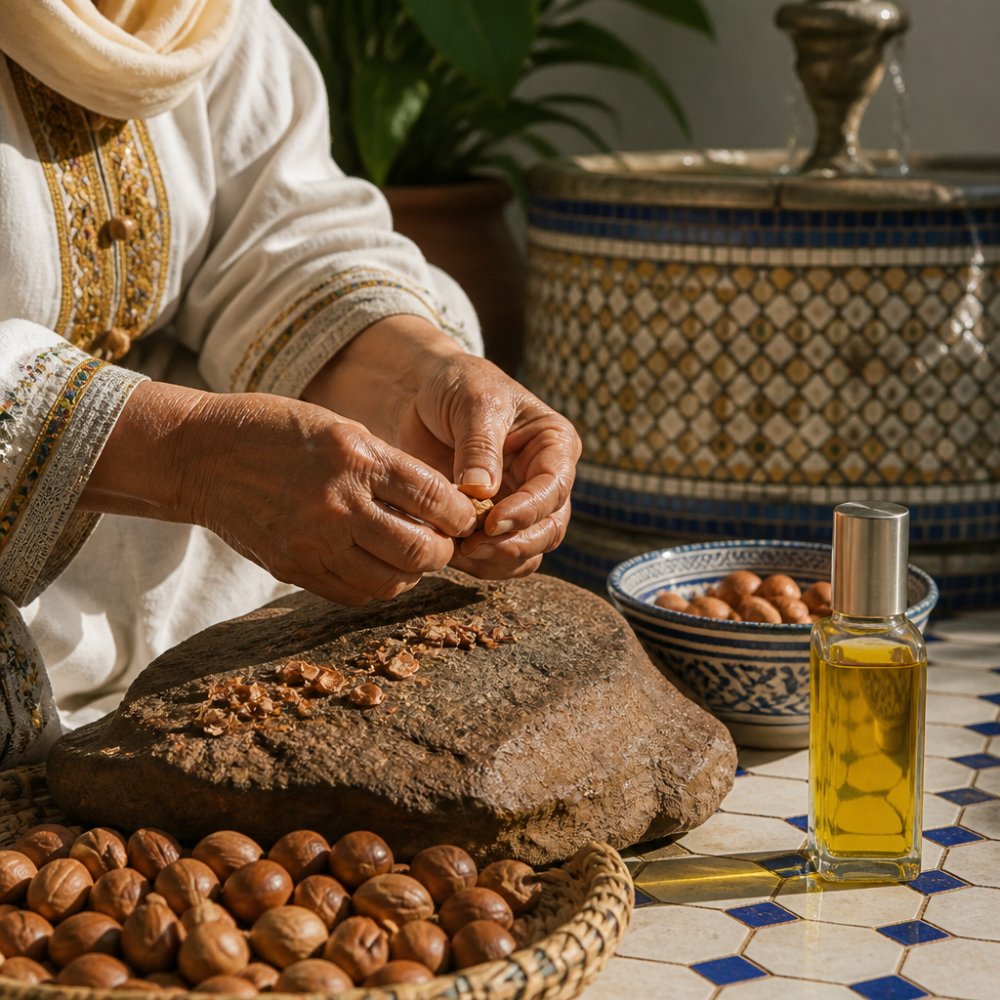
The argan tree is native to a specific semi-arid region, and its fruit ripens once a year.
Kernel Extraction: Hand-Cracking and Time Requirements
Hand-cracking is the most labor-intensive step. After the fruit dries, the hard shell must be opened to reach the kernel, still done by hand in most production because machines crush the kernel along with the shell. A skilled worker cracks a limited number of kernels per hour, and it takes many hours to fill a single bottle.
That labor is the largest single line item in the cost of genuine oil, and the step counterfeiters skip entirely.
Cold-Pressed vs. Chemical Extraction: Why Method Changes the Price
Cold-pressing is slower and less efficient than chemical extraction, and that inefficiency is the point. It uses mechanical pressure alone, preserving the fatty acids and tocopherols that give the oil its antioxidant properties and nutty aroma.
Higher extraction efficiency sounds like a win until you look at what's lost. For cosmetic use, cold-pressed oil is the standard worth paying for.
Geographic Scarcity and Production Yield: Why Origin Matters
Origin matters because the argan tree grows in a limited area and yield per tree is low.
Global demand has grown steadily as argan oil appears in more hair and skin products, but supply cannot grow on the same timeline. A tree takes years to become productive and the harvest comes once a year.
The scarcity is real, not manufactured. Any supplier claiming unlimited volume at low cost is blending or mislabeling.
How to Identify Authentic Argan Oil: A Practical Checklist
Authenticity is testable. Use this checklist before you buy, and again when the bottle arrives.
- Ingredient list says only "Argania spinosa kernel oil", no carrier oils, no fragrance, no fillers
- Packaging is dark glass, not clear plastic, light and heat accelerate oxidation
- Aroma is nutty and slightly earthy, not neutral, not perfumed
- Texture absorbs without a greasy film, pure oil sinks in within a minute or two
- Price is consistent with hand-cracking labor, if it's dramatically cheaper, assume dilution
- Certification is named and verifiable, organic certification or fair trade labels you can look up
- Sedimentation is minimal but not absent, a small amount of natural sediment is normal in unfiltered oil
If a bottle fails more than one of these, treat it as blended. The USDA organic regulations require specific standards before a product can carry an organic label, so a verifiable certification is one of the strongest signals you have.
Pure vs. Blended Argan Oil: Why Cheap Bottles Are Often Fake
Cheap "argan oil" is usually argan oil diluted with a cheaper carrier, and the label often doesn't say so clearly. The word "argan" on a front panel is not a regulated purity claim in most product categories, so a bottle can legally contain a small percentage and still lead with the name, that loophole explains most of the price gap.
What's Actually in a Diluted Bottle
The adulterants fall into a few predictable families, each chosen to mimic a property of real argan oil at a fraction of the cost:
- Sunflower, safflower, and soybean oil, the most common plant-based fillers. They're light, inexpensive, and absorb quickly, approximating argan oil's texture, but lack its tocopherol content and characteristic fatty acid ratio.
- Mineral oil and petrolatum-derived emollients, colorless, odorless, and extremely cheap. They sit on the skin rather than absorbing the way argan oil does, which is why a diluted product can feel greasy when a pure one doesn't.
- Silicone-based emollients (dimethicone, cyclomethicone), added to create slip and a smooth finish. They're why some cheap products feel silkier than pure oil, a sensory trick rather than a quality signal.
- Synthetic fragrance and color, used to mask the neutral smell of filler oils. Genuine cold-pressed argan oil has a distinct nutty, slightly earthy aroma; a perfumed or scentless product is a warning sign.
- Other cosmetic oils (jojoba, coconut, grapeseed), sometimes listed honestly as blend components, sometimes not. These aren't harmful, but they change the fatty acid profile and dilute the concentration of what you're paying for.
How Purity Testing Actually Works
Purity testing looks at the fatty acid profile. Genuine argan oil has a distinctive ratio of oleic acid (roughly 43-49%) to linoleic acid (roughly 29-36%), plus a characteristic sterol and tocopherol composition.
A second test is sterol analysis. Argan oil contains spinasterol, absent from most cheap carrier oils, so its presence is a reliable purity marker. A suspiciously low price usually means the product was never tested, because testing costs money and dilution is the business model.
Reading the Label Like a Tester
A few label patterns correlate strongly with dilution:
- "Argan oil" listed after water, alcohol, or a carrier oil, ingredients are listed in descending order by weight, so position tells the real story.
- "Argania spinosa" absent from the INCI list, the botanical name is what regulators and formulators use; a product that only says "argan" in marketing copy may not contain much of it.
- A long ingredient list on a product sold as pure oil, pure argan oil has one ingredient. Anything else is a blend, whether or not the front label admits it.
- A price far below the hand-cracking labor floor, if the bottle costs less than the labor required to crack the kernels inside it, the math doesn't work.
None of this requires a laboratory. The label, the ingredient order, and the price relative to the labor floor filter out most diluted products before you open the bottle.
Pure Argan Oil Benefits for Hair and Skin: What the Premium Buys
What the premium buys is the part of the oil that dilution removes.
For hair, the benefits show up as improved manageability and a less brittle feel over time, especially on dry or chemically treated strands.
Shelf stability matters here too. Pure oil oxidizes over time, which is why bottling standards favor dark glass and small bottles. Rancid oil loses its antioxidant value and can irritate skin.
Certifications, Shelf Life, and Supply Chain: What Competitors Skip
Supply chain transparency is where most brands get vague, and it separates a real premium product from a marked-up one. A producer who can tell you where the kernels were cracked, when the oil was pressed, and what testing was done has nothing to hide. One who can't usually has a reason.
The Certifications Worth Checking
Certifications are the paper trail, and each verifies something different:
- USDA Organic, verifies that the argan trees were grown without prohibited synthetic pesticides and that processing meets the USDA's National Organic Program standards. The USDA organic regulations spell out the requirements, and certified operations are subject to annual inspection.
- Fair Trade Certified, verifies that producers received a minimum price, a social premium, and that the supply chain meets labor and environmental standards. The Fair Trade Certified program publishes its producer requirements, so the claim is checkable rather than decorative.
- Fair for Life and ECOCERT, third-party social and environmental certifications common in the cosmetic-ingredient space. They cover fair trade and organic claims respectively, and both require periodic audits.
- Cruelty-free and vegan labels, verify animal-testing and animal-ingredient policies, not purity or origin. Useful, but they don't tell you whether the oil is genuine.
Both organic and fair trade certification cost money to obtain and maintain, application fees, inspections, and administrative work. That overhead is part of why certified oil costs more, and why uncertified producers can undercut certified ones without being dishonest about anything except the absence of verification.
Why Packaging and Shelf Life Change the Real Cost
Shelf-life and oxidation are the part buyers rarely factor in, and where the cheapest bottles quietly become the most expensive.
Argan oil is high in unsaturated fatty acids, which makes it useful for skin and hair and also prone to oxidation. As it oxidizes, it loses the tocopherols and fatty acids that justify the premium.
Three packaging decisions directly affect how fast that happens:
- Dark glass versus clear plastic, light accelerates oxidation, and glass is a better oxygen barrier than most plastics. Dark glass blocks the wavelengths that do the most damage.
- Bottle size, every time you open a bottle, fresh oxygen enters. A large bottle that takes months to finish is exposed to oxygen repeatedly, while a small bottle finishes before oxidation has much time to work.
- Pump or dropper versus open neck, a pump limits air exposure to the moment of dispensing, while an open bottle exposes the entire surface every time it's opened.
A cheap bottle in clear plastic is often a false economy.
| Factor | Cheap "Argan" Oil | Pure Cold-Pressed Oil |
|---|---|---|
| Ingredient list | Argan plus fillers | Argania spinosa only |
| Extraction | Solvent or heat | Cold-pressed |
| Kernel sourcing | Unverified | Traceable, hand-cracked |
| Certification | Rarely | Organic or fair trade |
| Packaging | Clear plastic, large format | Dark glass, small format |
| Shelf life | Shorter, prone to rancidity | Longer with proper bottling |
| Cost per use | Higher over time | Lower over time |
Conclusion: Paying for Purity, Not Packaging
The price of pure argan oil reflects hand labor, limited supply, and low extraction yield, not fancy packaging. When you pay more, you're paying for kernels cracked by hand, the cold-press that preserved the oil's fatty acids and tocopherols, and the testing that confirms nothing was added.
If you've been burned by diluted products before, the challenge is finding a bottle you can actually trust.
Frequently Asked Questions
Is real argan oil expensive?
Yes, authentic pure argan oil is expensive because each bottle requires 30 kilograms of fruit and about 15 hours of manual labor to produce one liter. The Moroccan argan tree grows in a limited region, and harvesting is done by hand. Cold-pressing and purity testing add further costs. If a bottle is sold for $15, it is likely blended or diluted with cheaper oils.
How to know if argan oil is 100% real?
Check the ingredient list: it should say only 'Argania Spinosa Kernel Oil' with no added fragrance or carrier oils. Look for organic certification such as USDA Organic or ECOCERT. Real argan oil has a light, nutty aroma and a thin texture that absorbs quickly. If it smells strongly perfumed or feels greasy, it may be cut with synthetic additives or cheaper oils.
What are the downsides of using argan oil?
Argan oil is generally well tolerated, but some people with sensitive skin may experience irritation from added fragrances or preservatives in blended products. Pure argan oil is non-comedogenic, so it rarely clogs pores. However, it can go rancid if stored improperly; keep it in a cool, dark place and use within 12 months. Always patch-test if you have allergies.
Why does authentic argan oil have a specific scent?
Authentic argan oil has a mild, nutty aroma because the kernels are gently roasted before pressing for culinary grade, while cosmetic grade is often unroasted and has a lighter scent. The natural scent comes from the oil's fatty acids and tocopherols, not added fragrance. A strong perfume smell usually indicates synthetic additives, and a rancid odor means oxidation.