
 blog
blog
10 Best Ways to Use Argan Oil for Nails
Table of Contents
- Why Argan Oil for Nails Deserves a Spot in Your Routine
- 10 Best Ways to Use Argan Oil for Nails
- How to Apply Argan Oil to Nails: Step-by-Step
- Argan Oil for Brittle Nails: What to Expect
- How Often to Use Cuticle Oil for Best Results
- Choosing a Natural Cuticle Oil and Storing It Right
- Conclusion
- Frequently Asked Questions
Last Updated: October 17, 2026
Why Argan Oil for Nails Deserves a Spot in Your Routine
Argan oil for nails is a plant-based treatment that softens cuticles, seals in moisture, and helps brittle nails look healthier over time.
Here is the honest version most guides skip: argan oil is a moisturizer, not a repair serum.
That distinction matters. Set realistic expectations and you will love this oil. Expect miracles and you will be disappointed.
Below, we walk through ten distinct ways to use it, how to apply it, and the safety details worth knowing before you start.
10 Best Ways to Use Argan Oil for Nails
Each method below solves a different problem. Some take seconds. Others are weekly rituals.
| Use | Best For | Frequency | Time Needed |
|---|---|---|---|
| 1. Deep cuticle hydration | Dry, tight cuticles | Daily | 1 minute |
| 2. Pre-bed treatment | Overnight repair | 3-5 nights weekly | 2 minutes |
| 3. Softening cracked cuticles | Cracked, painful edges | Twice daily until healed | 1 minute |
| 4. Post-manicure finish | Sealing a fresh manicure | After every manicure | 1 minute |
| 5. Weekly nail mask | Overall conditioning | Once weekly | 15 minutes |
| 6. Cuticle massage | Circulation and stress relief | 3-4 times weekly | 3 minutes |
| 7. Shine boost | Dull, matte nails | As needed | 1 minute |
| 8. Artificial nail care | Gel and acrylic upkeep | Daily | 1 minute |
| 9. Nail oil soak | Intensive hydration | Once weekly | 10 minutes |
| 10. Hand and nail treatment | All-over moisture | Daily | 2 minutes |
1. Deep Cuticle Hydration
Warm one to two drops between your fingertips and press it into each cuticle. The oil absorbs quickly and leaves no greasy film.
This is the simplest daily habit, and it is the one that pays off fastest. Dry cuticles snag, tear, and invite infection. Hydrated ones stay flat and comfortable.
2. A Pre-Bed Nail Treatment
Apply a drop to every nail and cuticle right before sleep. Slip on cotton gloves if you want the oil to stay put.
Overnight is when the oil has hours of uninterrupted contact with your skin. You will notice softer cuticles by morning.
3. Softening Dry or Cracked Cuticles
Cracked cuticles need consistency more than quantity. Apply a small amount after every hand wash, while skin is still slightly damp.
The oil traps that residual water against the skin. That combination does more for cracked edges than a heavy application on dry skin.
4. A Post-Manicure Finish
Once polish is fully dry, massage a drop along the cuticle line. It restores moisture that polish remover and filing strip away.
Skip this if you have just had gel cured. Oil on uncured gel can interfere with adhesion, so wait until the next day.
5. A Weekly Nail Mask
Coat all ten nails generously, then wrap each fingertip in a warm damp cloth for ten to fifteen minutes. Rinse and pat dry.
Think of it as a deep conditioning session for your hands. It is a luxurious ritual you can do at home.
6. Nail and Cuticle Massage
Massage is where argan oil earns its keep beyond moisture. Work the oil into each cuticle in small circles for twenty to thirty seconds.
Massage boosts blood flow to the nail bed. It also happens to be one of the most relaxing two minutes of your day.
7. A Shine and Appearance Boost
A single drop buffed over bare nails gives a soft, healthy sheen. No polish required.
This works because the oil fills tiny surface irregularities that scatter light. The effect is subtle and temporary, but it photographs beautifully.
8. Care for Artificial Nails and Gel Polish
Artificial nails still sit on living tissue, and that tissue still dries out. Apply oil to the cuticle and skin around the nail, not directly on the gel surface.
Keeping the surrounding skin conditioned helps prevent the lifting and irritation that make a set look tired before its time.
9. A Nail Oil Soak
Fill a shallow bowl with warm water and add several drops of argan oil. Soak your fingertips for ten minutes, then massage in the residual oil.
Warm water opens the nail plate slightly, and the oil follows. This is a Sunday-evening reset that takes almost no effort.
10. A Multi-Use Hand and Nail Treatment
Argan oil is not just a nail product. Use the leftover on your hands, elbows, and any rough patches.
Our pure organic Argan Oil doubles as a skin moisturizer, so one bottle can handle your hands and nails in a single step.
How to Apply Argan Oil to Nails: Step-by-Step
Here is the method we recommend, start to finish. It takes about two minutes.
What you'll need: pure argan oil in a dropper bottle, a soft towel, and clean hands.
- Wash and dry your hands. Pat them partly dry so skin stays slightly damp.
- Dispense one to two drops into your palm. A little goes a long way.
- Warm the oil by rubbing your palms together for a few seconds.
- Press, don't rub, the oil into each cuticle with your fingertip.
- Massage in circles around each nail for twenty to thirty seconds.
- Sweep the remainder over the nail plate and knuckles.
- Wait two to three minutes for absorption, then blot any excess.
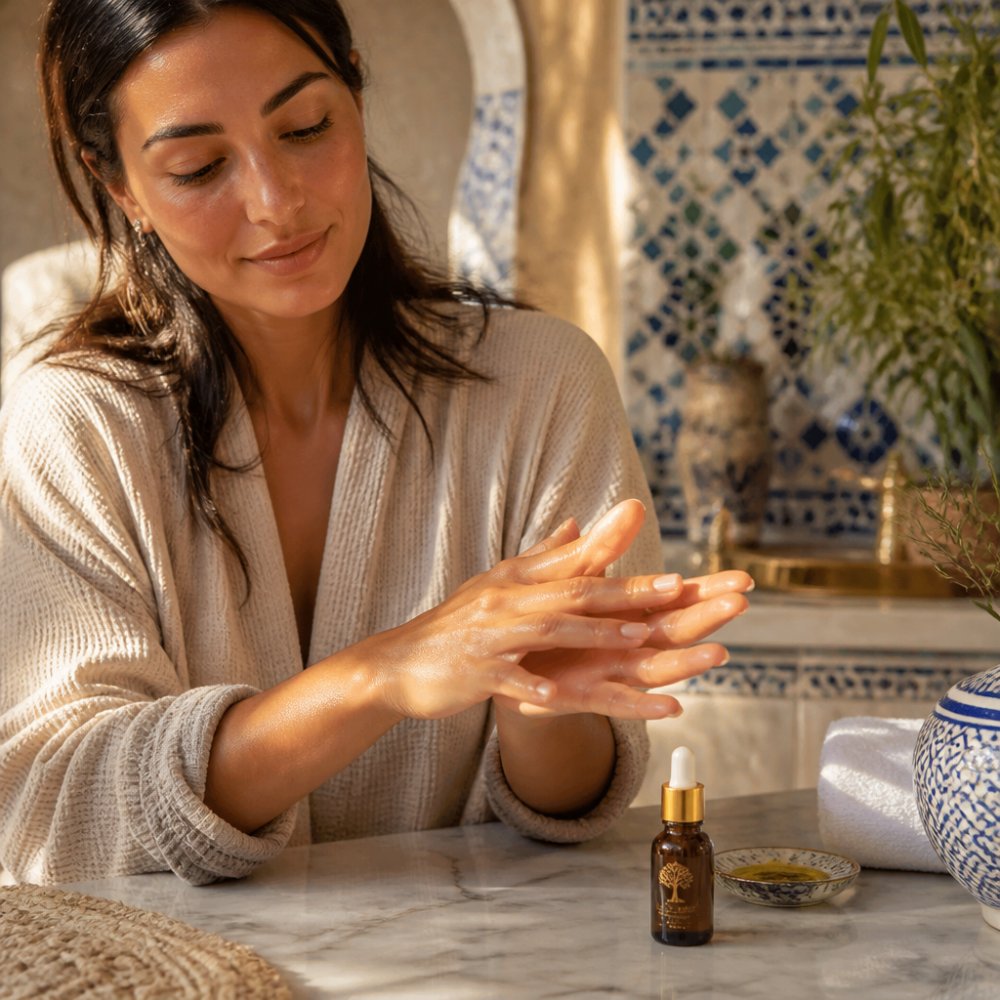
Expected result: softer cuticles within a few days and less snagging within a week.
Argan Oil for Brittle Nails: What to Expect
Brittle nails are a symptom, not a single condition.
What oil can realistically do:
- Reduce water loss from the nail plate. The nail plate is porous and loses moisture every time you wash your hands or use hand sanitizer. A thin layer of oil slows that loss, which keeps the plate from becoming rigid and prone to splitting.
- Improve flexibility at the free edge. Nails that bend slightly are less likely to snap than nails that are dry and stiff. Consistent oiling supports that flexibility.
- Condition the surrounding skin. Most 'brittle nail' complaints are really cuticle complaints, dry, ragged skin that snags and tears. Oil addresses that directly.
What oil cannot do:
- It cannot fuse a split that has already formed. The only fix for an active split is to file past it and let it grow out.
- It cannot change the rate of nail growth. Growth is governed by genetics, age, circulation, and overall health, not by topical oil.
- It cannot correct brittleness caused by an underlying condition. If your nails are pitted, ridged in a new pattern, discolored, or separating from the nail bed, those are signs to see a dermatologist rather than to buy another bottle.
A realistic timeline:
Nails grow slowly, roughly 3 to 4 millimeters per month on the hands, and a full replacement of a fingernail takes about six months.
Common causes oil will not fix on its own:
- Repeated wet-and-dry cycles from dishwashing or cleaning without gloves
- Harsh solvents, acetone, and frequent polish removal
- Thyroid conditions and other systemic issues
If you have addressed the everyday causes and your nails are still splitting, peeling, or lifting, that is a conversation for a clinician, not a product swap.
How Often to Use Cuticle Oil for Best Results
Frequency is the single biggest variable in whether argan oil works for you. The right answer depends on how often your hands are in water, what climate you live in, and whether you wear polish or artificial nails.
The baseline:
- Once daily is the minimum for most people. Apply at night so the oil has hours of contact before your next hand wash.
- Two to three times daily if your hands are frequently wet, food service, healthcare, cleaning, childcare, or frequent hand sanitizer use.
- After every hand wash if you are actively healing cracked or split cuticles. This is temporary; drop back to twice daily once the skin has recovered.
How much to use:
One to two drops total is enough for all ten nails. More than that is wasted, the excess sits on the surface and transfers to whatever you touch.
Timing that matters:
- After hand washing, while skin is still slightly damp. Oil seals in residual water; applied to bone-dry skin it does less.
- Before bed. Overnight contact is the most efficient use of the oil.
- After polish removal, not before. Remover strips oil along with polish, so applying first wastes the product.
Adjusting for climate and season:
- Winter and low-humidity climates: increase to twice daily. Indoor heating pulls moisture from skin faster than most people realize.
- Summer and humid climates: once daily is usually sufficient unless you swim or spend long hours in water.
- Frequent swimming: apply after every swim. Chlorine and prolonged water exposure are hard on both cuticles and nail plates.
A simple weekly rhythm:
| Day | Routine |
|---|---|
| Most days | One drop at night, massaged into cuticles |
| Days with heavy hand washing | Add one application after the last wash |
| Once weekly | A longer soak or mask session |
| After any manicure removal | Apply the same evening |
Consistency beats intensity. A single drop every day outperforms a heavy application once a week, because the goal is keeping the nail plate and cuticle skin consistently conditioned rather than flooding them occasionally.
Choosing a Natural Cuticle Oil and Storing It Right
Look for a short ingredient list and a dark glass bottle. Pure argan oil should list one ingredient: argan oil.
What to check before buying:
- Ingredient list: single-ingredient oil, no added fragrance or mineral oil
- Packaging: dark glass protects the oil from light damage
- Scent: mild and nutty, never sharp or rancid
Store your bottle away from direct sunlight and heat. A cool cabinet is fine. Properly stored oil stays fresh for months, and a small bottle is smarter than a large one you cannot finish.
If you want guidance on building a full routine, our team offers treatment consultations and a curated online shop with pure organic argan oil.
Conclusion
The hardest part of nail care is not finding a product. It is remembering to use it. A bottle of pure argan oil, kept where you can see it, solves that problem better than any ten-step routine.
At Renaissance de Beaute Argan Treatments, we source authentic Moroccan argan oil because the ingredient quality is paramount.
Start with one drop a day. Your cuticles will tell you it is working within a week.
Frequently Asked Questions
Can you use argan oil on your nails?
Yes. Argan oil is a plant-based oil that softens dry cuticles and conditions the nail plate, so it is a simple addition to nail care. Apply two or three drops to clean, bare nails and massage it in until absorbed. It works as a daily cuticle treatment, a post-manicure finish, or a pre-bed ritual. If you have sensitive skin or allergies, do a patch test on a small area first and stop if irritation appears.
How often should you use argan oil on your nails?
Most people get good results from daily application, especially before bed when the oil can soak in overnight. If your cuticles are very dry or cracked, apply it two or three times a day after washing hands. For general maintenance, once a day plus a weekly nail mask is enough. Consistency matters more than quantity: a few drops massaged in each time is plenty, and more oil does not speed up results.
Should you apply argan oil before or after nail polish?
Apply argan oil to bare nails and cuticles before polish only if you wipe the nail plate clean afterward, because oil stops polish from sticking. The better routine is to use it after polish has fully dried, focusing on the cuticles and surrounding skin. It also helps between manicures: massage it into bare nails for a day or two to condition the plate before your next application of polish or artificial nails.
Is argan oil safe for sensitive skin and allergies?
Pure argan oil is generally well tolerated, but no oil is risk-free for every person. Do a patch test on your inner wrist or a small cuticle area and wait 24 hours before regular use. Stop if you notice redness, itching, or swelling. If you have a known nut allergy or a skin condition under a dermatologist's care, ask them before adding a new oil to your routine, and keep the oil away from broken skin.
Dry, cracked cuticles and brittle nails rarely fix themselves, but a daily oil habit gets you most of the way there. Renaissance de Beaute Argan Treatments offers pure organic Moroccan argan oil plus traditional Hammam-inspired essentials for a complete at-home ritual. Browse the Renaissance Online Shop or reach out for a personalized consultation and build a routine that fits your skin.